

Table of Contents
- The Labor-Intensive Weaving Process Behind Antique Persian Rugs
- Hand-Knotted vs Machine-Made Rugs: Understanding the Cost Difference
- Superior Materials: Silk, Wool, and Natural Vegetable Dyes
- How to Identify Antique Persian Rugs and Verify Authenticity
- Knot Density, Craftsmanship, and Quality Standards
- The Persian Rug Appraisal Process and Market Value
- Investment Grade Rugs: Appreciation, Rarity, and Collectibility
- Conclusion
Last Updated: August 13, 2026
The Labor-Intensive Weaving Process Behind Antique Persian Rugs
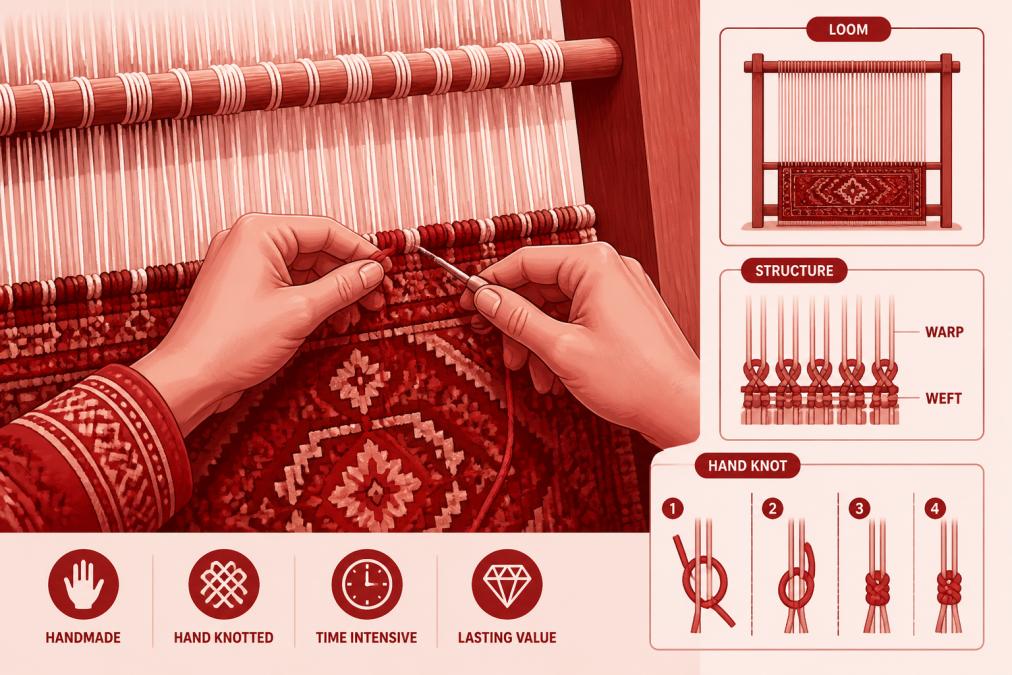
Antique Persian rugs are expensive primarily because they're handmade using labor-intensive techniques that take months or even years to complete. A master weaver sits at a loom with hundreds of colored threads, tying thousands of individual knots by hand. Each knot requires years of training to execute correctly. The foundation setup alone, stringing warp and weft threads across the loom, can take weeks for larger rugs.
A weaver working eight hours daily might complete only a few inches of a rug in a week. For a large room-sized rug measuring 10 feet by 14 feet, a team of skilled artisans may invest 1,000 to 2,000 hours of labor. This translates directly into the final price: labor costs form the largest component of an antique Persian rug's value. Traditional weaving techniques demand focus, precision, and an understanding of how color and pattern interact across the entire piece. A weaver cannot simply speed up without introducing errors that compromise structural integrity and aesthetic appeal.
Hand-Knotted vs Machine-Made Rugs: Understanding the Cost Difference
Hand-knotted rugs are tied individually by human hands, while machine-made rugs are produced by mechanical looms at industrial speed. Machine-made rugs can be produced in days or weeks and typically cost between $300 and $1,500. Authentic hand-knotted Persian rugs start at $1,500 and can reach tens of thousands of dollars. The price difference reflects not just labor time, but also durability and longevity.
Hand-knotted rugs outlast machine-made alternatives by decades. The individual knots create a structure that can be repaired, cleaned, and restored without falling apart. Machine-made rugs, once damaged, are often discarded because the mechanical construction doesn't allow for meaningful repair. Over time, authentic hand-knotted Persian rugs develop a patina, a subtle sheen from natural wear, that is prized by collectors as a sign of authenticity and age. Machine-made rugs never develop this characteristic and hold no investment value.
At ABC Rugs Kilims & Jewelry, we specialize in sourcing authentic hand-knotted pieces that reflect genuine craftsmanship. Our curated collection includes pieces like the One of a Kind Hand-Knotted Persian Wool Rug, a luxurious vintage design measuring 10'7" by 7' that showcases the artisan quality that defines true value in this market.
Superior Materials: Silk, Wool, and Natural Vegetable Dyes
The materials used in antique Persian rugs directly determine their cost, durability, and aesthetic appeal. Wool is the most common fiber because it's durable, takes dyes beautifully, and ages well. Silk, used either as the primary fiber or as accents, commands a premium because it creates a luminous surface and allows for finer knot densities. Pure silk rugs are among the most expensive textiles in the world, often priced in the five-figure range.
Natural vegetable dyes come from plants, minerals, and insects, indigo for blue, madder root for red, and pomegranate for yellow. Extracting and applying natural dyes requires expertise and time. The resulting colors are more subtle and complex than synthetic dyes, and they age beautifully, developing richer tones over decades. A rug dyed with natural vegetable dyes costs 30 to 50 percent more to produce than one using chemical dyes, but this investment pays dividends in longevity and aesthetic appeal. Collectors recognize natural dyes as a marker of quality and authenticity, which is why rugs employing them command higher resale values.
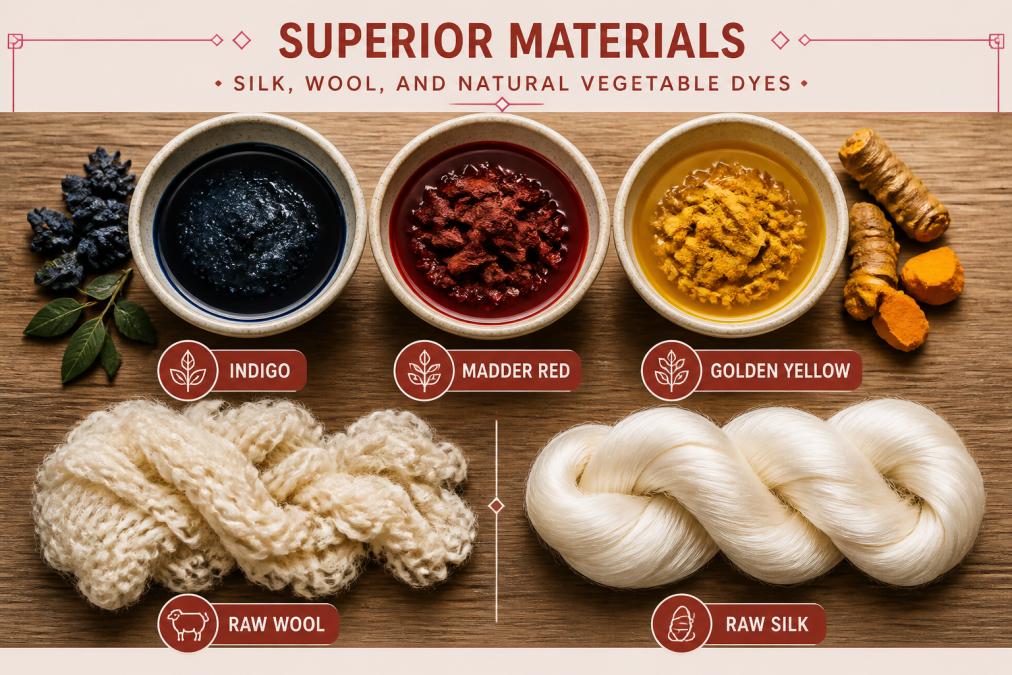
The foundation threads (warp and weft) are typically cotton or wool, and their quality affects how well the rug holds up over time. Premium rugs use hand-spun cotton or wool for these foundation threads, providing superior strength and flexibility compared to machine-spun alternatives. This detail, invisible to the casual observer, is one reason antique Persian rugs are expensive: every component reflects a commitment to quality.
How to Identify Antique Persian Rugs and Verify Authenticity
Identifying authentic antique Persian rugs requires understanding several key markers of genuineness. The first step is examining the knot structure from the back of the rug. Authentic hand-knotted Persian rugs show individual knots when viewed from behind, each visible as a small bump or loop. Machine-made rugs display a uniform, printed appearance on the back with no visible knots.
Check the knot density by counting knots in a one-inch square. Authentic Persian rugs typically have between 100 and 400 knots per square inch, depending on the region and quality level. A simple magnifying glass and ruler allow you to perform this test yourself.
Examine the dyes by looking at color consistency and fade patterns. Natural vegetable dyes show subtle color variations across the rug because the dyeing process is inherently inconsistent, this is actually a sign of authenticity. Synthetic dyes produce uniform color that looks flat and artificial. Additionally, authentic antique rugs show uneven fading that follows light exposure patterns, creating a natural patina.
The fringe at the ends of the rug provides another authentication clue. Authentic Persian rugs have fringes integral to the weave, with warp threads extending beyond the knots. If the fringe appears sewn on or is a different color than the warp threads, the rug is likely a reproduction.
Some Persian rugs include a weaver's mark woven into the design, particularly those from cities like Isfahan and Tabriz. These signatures are difficult to replicate and serve as proof of origin and authenticity. However, the absence of a signature doesn't indicate a fake rug.
Knot Density, Craftsmanship, and Quality Standards
Knot density, measured in KPSI (knots per square inch), is one of the most reliable indicators of quality in antique Persian rugs. A rug with 100 KPSI contains 10,000 individual knots per square inch. A rug with 300 KPSI contains 30,000 knots in that same space. A weaver producing 100 KPSI can complete a square foot in roughly 8 to 10 hours, while the same weaver producing 300 KPSI might require 24 to 30 hours per square foot. This exponential increase in time translates directly to price.
Knot density also correlates with pattern complexity and color gradation. Fine rugs with high KPSI allow weavers to create intricate geometric motifs, detailed floral patterns, and smooth color transitions that would be impossible at lower densities. The relationship between knot density and durability is also significant: rugs with higher KPSI wear more slowly because the individual knots are smaller and more densely packed.
Craftsmanship extends beyond knot density to include color harmony, pattern balance, and technical execution. A master weaver makes thousands of micro-decisions about color placement, knot tension, and pattern proportions. A rug woven by a master craftsman with 40 years of experience commands a higher price than one woven by a journeyman, even if the KPSI is identical.
The Persian Rug Appraisal Process and Market Value
Understanding how antique Persian rugs are appraised clarifies why they command such high prices and why values vary significantly between pieces. A professional appraiser begins by determining the rug's age. Antique rugs are typically defined as pieces at least 100 years old, while semi-antique rugs range from 50 to 100 years old.
The appraiser then assesses condition. Has the rug been professionally cleaned and restored? Are there repairs, fading, or damage? Restoration work can increase value if performed by a skilled conservator using period-appropriate techniques. A rug with original, unaltered patina typically commands a premium.
Regional origin is another critical appraisal factor. Rugs from famous weaving centers like Isfahan, Tabriz, Kashan, and Qum are generally more valuable than those from lesser-known regions. A Tabriz rug with identical specifications to an unknown village rug will typically appraise for 20 to 40 percent higher value.
Materials, dyes, rarity, and pattern distinctiveness also factor into valuation. A rug with a unique or unusual pattern will appraise higher than one with a common design.
Investment Grade Rugs: Appreciation, Rarity, and Collectibility
The finest antique Persian rugs function as tangible investments, appreciating in value over time. Investment-grade rugs share several characteristics: they're authentically hand-knotted with high knot densities (typically 150 KPSI or higher), feature natural vegetable dyes, come from established weaving centers with documented histories of quality production, and are in excellent condition or professionally conserved.
Rarity is the most powerful driver of appreciation. A rug that's one of only a handful known to exist in a particular pattern will appreciate more substantially than a common design. Collectors actively seek out these rare pieces, driving demand and prices upward. Auction results at major houses like Christie's or Sotheby's provide public evidence of market values and carry additional credibility.
Collectibility encompasses both aesthetic appeal and historical significance. A rug with exceptional color harmony and balanced proportions will appreciate more than one with awkward proportions. Similarly, a rug documenting a specific historical period or representing a rare weaving technique holds greater appeal to serious collectors.
ABC Rugs Kilims & Jewelry curates inventory specifically for collectors seeking investment-grade pieces. Our selection process prioritizes authenticity, rarity, and documented provenance, the factors that drive long-term appreciation. When you purchase from our reviewed and trusted collection, you're acquiring pieces with genuine collectibility and investment potential.
Conclusion
Antique Persian rugs command premium prices because they represent a convergence of factors: labor-intensive hand-knotting processes that require months or years of work, superior materials including natural dyes and hand-spun fibers, exceptional craftsmanship from master weavers, and genuine rarity in the marketplace. These aren't merely decorative objects, they're textile art that improves with age, functions as a tangible investment, and carries historical and cultural significance.
When evaluating antique Persian rugs, prioritize authentication, knot density, material quality, and documented provenance. At ABC Rugs Kilims & Jewelry, we specialize in sourcing and curating authentic hand-knotted pieces that meet these standards. Our reviewed and trusted collection ensures you're investing in genuine craftsmanship and artistry. Explore our carefully selected inventory of hand-knotted Persian rugs and discover pieces that will enhance your space while preserving value for generations to come.
Frequently Asked Questions
How can I tell if a Persian rug is actually antique versus a reproduction?
Authentic antique Persian rugs show specific signs: hand-knotted construction with irregular knots, natural dye variations that fade predictably, and a patina that develops over decades. Check the back for symmetrical knot patterns and examine the pile for wear consistent with age. The warp and weft should show natural fiber aging. Reproductions often have uniform, machine-like knots and synthetic dyes with uniform color. Professional appraisal can confirm age through fiber analysis and design documentation.
What factors most influence the price of an antique Persian rug?
The primary factors are knot density (measured in KPSI, knots per square inch), age, materials, and provenance. Hand-knotted rugs with 200+ KPSI cost significantly more than lower densities. Rugs made entirely from silk or high-grade wool command premium prices. Documented provenance and regional origin (Tabriz, Isfahan, Heriz) affect value. Condition, rarity of design, and historical significance also drive pricing. A well-preserved semi-antique rug with strong provenance typically appreciates 3-5% annually.
Are antique Persian rugs a good investment?
Yes, investment-grade antique Persian rugs have historically appreciated in value, particularly those with excellent provenance and condition. Auction records show rare pieces appreciating 5-10% annually over decades. However, not all rugs appreciate equally, regional origin, knot density, and documented authenticity matter. Maintenance costs should be factored in; professional cleaning runs $300-$800 depending on size. Collectors should purchase for both aesthetic and investment value, understanding that liquidity varies and authentication is essential for resale.
What's the difference between a hand-knotted and machine-made rug, and why does it matter for price?
Hand-knotted rugs are tied individually by artisans, creating irregular, organic knots and allowing infinite design complexity. A single rug takes months to years to complete. Machine-made rugs are manufactured in days with uniform, perfect knots and limited design variation. Hand-knotted rugs develop natural patina and improve with age, while machine-made rugs deteriorate. Antique Persian rugs are exclusively hand-knotted, which is why they command premium prices, they represent irreplaceable textile art and cultural heritage that only becomes more valuable over time.
This article was written using GrandRanker


